Sep 11, 2026
EDI vs Mixed-Bed Polishing for Industrial Ultrapure Water
Compare EDI and mixed-bed polishing after RO: feedwater limits, regeneration, operating continuity and the data needed for a reliable selection.
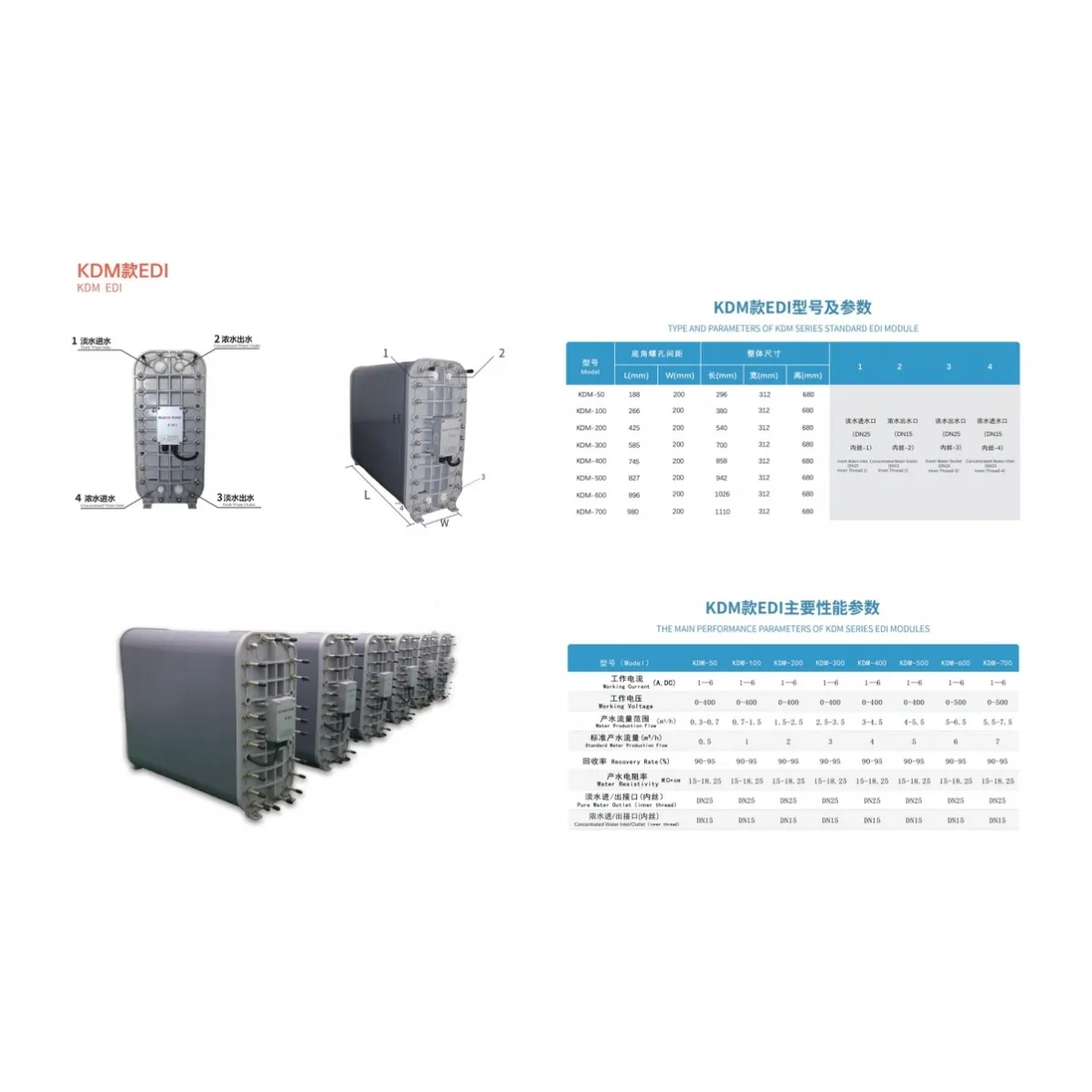
Electrodeionization (EDI) and mixed-bed ion exchange can both polish reverse-osmosis permeate, but they solve the duty in different ways. The best choice depends on feedwater stability, required product-water quality, operating continuity, chemical-handling policy and the role of the polishing stage in the complete system.
The useful question is not simply “Which technology makes purer water?” It is “Which polishing arrangement can reliably meet this project’s specification under its real operating conditions?”
Short answer: consider EDI for continuous ionic polishing of suitably conditioned RO permeate; consider mixed-bed ion exchange where regeneration or resin exchange fits the operating plan, or where a final polishing barrier is needed. Neither choice removes the need to define feed limits and the final water specification.
Quick comparison
Operating principle: EDI combines resin, ion-selective membranes and an electric field. A mixed bed contains cation and anion exchange resins in one vessel.
Position in the train: EDI typically follows suitably conditioned RO permeate. A mixed bed may provide demineralization or final polishing after RO/EDI.
Regeneration: EDI regenerates its resin electrically during operation. A mixed bed needs chemical regeneration or a resin/cylinder replacement service, depending on its design.
Changing feed quality: EDI must stay within its module's operating envelope. Mixed-bed capacity is consumed as the contaminant load increases.
Operating plan: assess EDI electrical and hydraulic control alongside mixed-bed breakthrough monitoring, regeneration logistics and waste handling.
These are common engineering roles, not guaranteed performance specifications. Actual limits must follow the selected equipment supplier’s technical manual and the project water analysis.
How EDI works
EDI combines ion-exchange resin, ion-selective membranes and direct-current electricity. Dissolved ions migrate out of the diluting compartments while the electric field continuously regenerates the resin’s active sites. This allows EDI to operate as a continuous polishing process without routine acid-and-caustic regeneration of the module.
DuPont describes its EDI-310 module as a replacement for conventional mixed-bed ion exchange when polishing RO permeate in a continuous chemical-free system. That positioning also reveals the central design condition: EDI is normally applied to suitably treated RO permeate, not directly to untreated raw water.
How mixed-bed polishing works
A mixed bed combines strong-acid cation and strong-base anion resins so that cation and anion exchange occur repeatedly through the bed. It can achieve very low ionic leakage when the resin is correctly selected, regenerated and operated.
Mixed beds may be regenerated on site, exchanged as service cylinders, or used as a final polishing safeguard. Veolia’s Aquadem description, for example, notes that mixed-bed resin can polish pretreated water, including RO or EDI product water. The exact operating model affects chemical storage, waste generation, downtime and service planning.
Selection factor 1: feedwater quality
EDI performance depends strongly on the quality of the RO permeate entering the module. The engineering review should consider conductivity, hardness, silica, carbon dioxide, temperature, pH, oxidants, organics and microbiological risk. Feedwater outside the selected module’s limits can cause scaling, fouling, high electrical load or unstable product quality.
A mixed bed can absorb an ionic load until its capacity is exhausted. That does not make it immune to poor feedwater: higher leakage or contaminant loading shortens the run length and increases regeneration or replacement frequency.
Selection factor 2: continuous operation and downtime
EDI is attractive where continuous production and reduced routine chemical regeneration are priorities. The system still needs appropriate pretreatment, monitoring, maintenance and provisions for cleaning or module service.
A regenerated mixed bed has a finite service run. Continuous plants may require duty/standby vessels or service-cylinder logistics so one bed can remain available while another is regenerated or replaced.
Selection factor 3: chemicals, waste and operator capability
On-site mixed-bed regeneration can require acid, caustic, neutralization and trained handling procedures. Off-site exchange avoids on-site regeneration equipment but introduces service logistics and recurring cylinder or resin costs.
EDI avoids routine regenerant use inside the module, but it consumes electrical power and depends on controlled feedwater. “Chemical-free” should therefore be interpreted narrowly: it refers to continuous resin regeneration within the EDI process, not necessarily to the entire upstream water-treatment plant.
Selection factor 4: final water specification
Define the product requirement in measurable terms: resistivity or conductivity, silica, sodium, total organic carbon, microbial limits and any process-specific contaminants. Semiconductor, pharmaceutical, power and general industrial users may require different combinations of ionic, organic and microbiological control.
Some ultrapure-water trains use RO followed by EDI. Others add a downstream mixed bed or another polishing step for a particular contaminant or risk-control objective. Veolia documents one ultrapure-water application combining RO, EDI and a mixed-bed polishing loop, illustrating that the technologies can be complementary rather than mutually exclusive.
Questions to answer before choosing
What are the minimum, average and maximum RO-permeate conductivity and temperature?
Are hardness, silica, carbon dioxide and oxidant residual within the selected EDI module’s limits?
What product-water parameters must be guaranteed, and at which sampling point?
Must the plant operate continuously, and what redundancy is required?
Are acid and caustic storage, regeneration waste and trained operators acceptable?
Is off-site resin exchange practical at the project location?
What monitoring will detect product-water deterioration or resin breakthrough?
How will the polishing stage be sanitized, cleaned and maintained?
Practical selection framework
Choose the process only after reviewing the complete water balance and operating plan:
Consider EDI when stable, suitable RO permeate is available and continuous polishing with reduced routine regenerant handling is important.
Consider a mixed bed when batch operation, service exchange, final guard polishing or a specific risk-control role fits the project better.
Consider a combined train when the final specification or reliability strategy requires more than one polishing barrier.
Final equipment selection must be confirmed from the actual feedwater, required capacity, product-water specification and site conditions.
Compare proposals on the same operating duty
Ask bidders to state the same feedwater envelope, delivered flow, operating hours, quality measurement point and redundancy requirement. A low equipment price is not a meaningful comparison if one proposal excludes pretreatment, standby capacity or regeneration-waste handling.
For an international project, request separate allowances for electrical use, consumables, cleaning, service visits, critical spares and planned downtime. Confirm who will supply replacement resin or modules at the installation location. These are project-specific purchasing questions—not a claim that either technology always has a lower operating cost.
How WaterEPC supports preliminary selection
WaterEPC can review available RO-permeate data, production requirements and target product-water quality to prepare a preliminary polishing-process discussion. Send the available analysis and operating requirements to inquiry@waterepc.com. WhatsApp: 008613112246878.
Frequently asked questions
Does EDI completely eliminate chemicals from a water plant?
No. EDI avoids routine acid-and-caustic regeneration of the module, but upstream pretreatment, RO cleaning, pH control or sanitation may still involve chemicals.
Can EDI treat raw water directly?
EDI is generally used to polish appropriately treated RO permeate. The exact feed limits must follow the selected module’s technical documentation.
Is a mixed bed always installed after EDI?
No. It depends on the final specification and reliability strategy. Some systems use EDI as the final ionic-polishing step; others add a mixed bed or another polishing process.
Which option is better for remote projects?
The answer depends on operator skills, chemical availability, spare-parts access, service-cylinder logistics, feedwater stability and redundancy. Remote location alone does not determine the technology.
Technical references
Related equipment and next steps
Explore the KDM Series EDI Module, KXGW High-Temperature EDI Module and Two-Pass RO + EDI Ultrapure Water System. Confirm each proposed model's actual limits rather than applying another manufacturer's specifications to it.
Request a preliminary selection review: send your RO-permeate analysis, required flow, water-quality specification and operating schedule to inquiry@waterepc.com.